


Published: 2026-02-05 18:45
AI Method Links CXR Evidence to CT Quantification for ILD Diagnosis
A new artificial intelligence (AI) method has emerged, aiming to bridge the diagnostic gap between chest X-rays (CXRs) and the more detailed information provided by computed tomography (CT) scans for interstitial lung diseases (ILDs). Published in npj Digital Medicine, this research proposes an AI approach that aligns CXR findings with quantitative CT measurements, potentially offering a more streamlined and accurate pathway for ILD diagnosis.
ILDs represent a complex and heterogeneous group of lung conditions characterised by inflammation and fibrosis of the lung interstitium. Early and accurate diagnosis is crucial for effective management and can significantly impact patient prognosis.
However, the diagnostic process is often challenging, relying on a combination of clinical assessment, pulmonary function tests, and multi-modality imaging, frequently requiring input from a multi-disciplinary team (MDT).
The Diagnostic Landscape of Interstitial Lung Diseases
Interstitial lung diseases encompass over 200 distinct conditions, including idiopathic pulmonary fibrosis (IPF), sarcoidosis, hypersensitivity pneumonitis, and connective tissue disease-associated ILD. These conditions often present with non-specific symptoms such as breathlessness and cough, making initial clinical differentiation difficult.
The progressive nature of many ILDs underscores the need for timely intervention. Misdiagnosis or delayed diagnosis can lead to irreversible lung damage and poorer outcomes. In the UK, specialist ILD centres and MDTs play a vital role in navigating these complex diagnoses, ensuring patients receive appropriate care.
Traditional Imaging in ILD: CXR and CT
Imaging plays a pivotal role in the diagnosis and management of ILDs. Chest X-rays are typically the first-line imaging modality due to their wide availability, low cost, and ease of use.
While CXRs can reveal abnormalities suggestive of ILD, such as reticular or nodular opacities, their two-dimensional nature and limited resolution often preclude a definitive diagnosis.

High-resolution computed tomography (HRCT) of the chest is considered the gold standard for imaging ILD. HRCT provides detailed anatomical information, allowing clinicians to identify characteristic patterns (e.g., usual interstitial pneumonia (UIP), non-specific interstitial pneumonia (NSIP)) that are critical for diagnosis and classification.
Furthermore, HRCT enables quantification of disease extent, which can be important for assessing severity and monitoring progression.
Despite their respective strengths, a significant challenge lies in effectively linking the initial, often qualitative, findings from a CXR with the precise, quantitative data derived from an HRCT. This is where the new AI method aims to make a substantial impact.
A Novel AI Approach: Linking CXR to CT Quantification
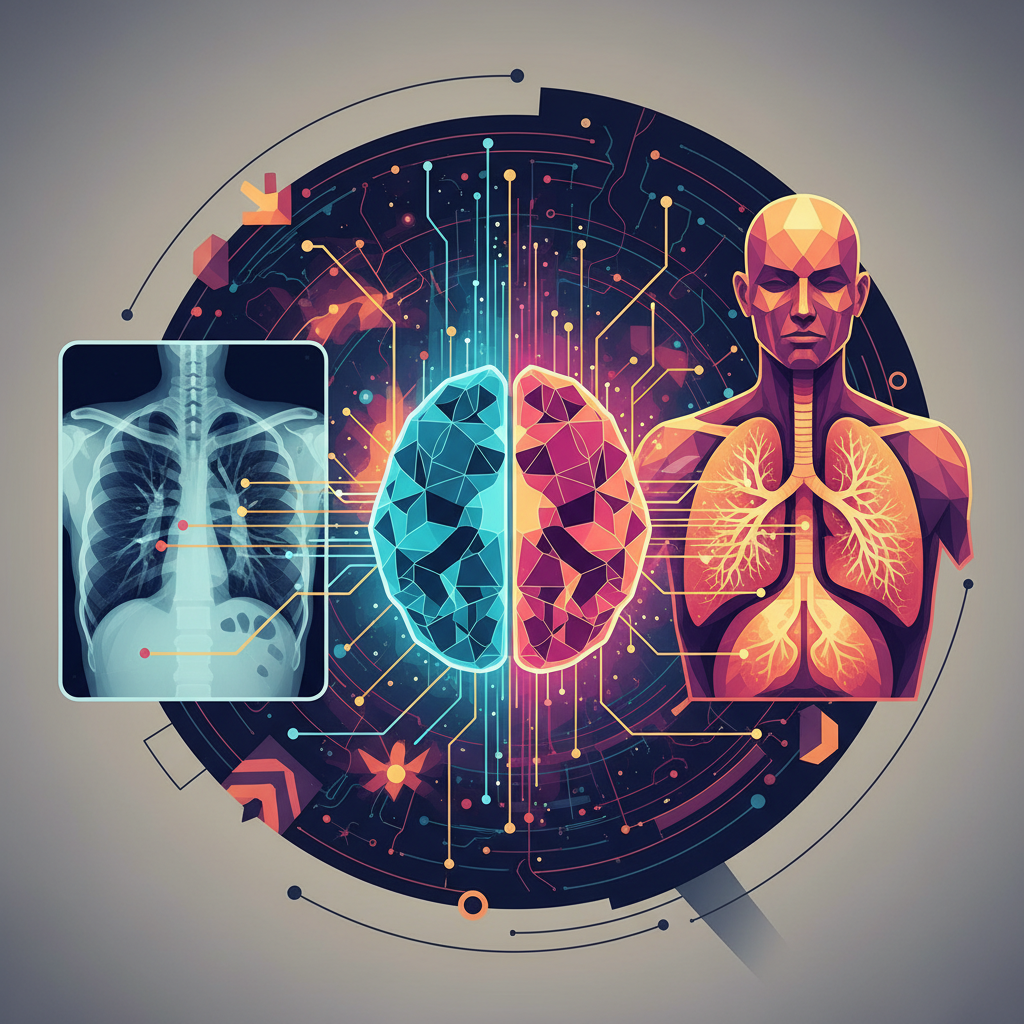
The research introduces an AI method designed to establish a direct link between the visual evidence on a CXR and the quantitative measurements obtained from a CT scan. This involves a sophisticated “text-image alignment” technique, suggesting the AI model learns to correlate descriptive radiological text (e.g., from CXR reports) with specific image features across different modalities, or directly aligns features between the images themselves.
Essentially, the AI is trained to interpret subtle patterns and characteristics on a CXR that might be indicative of ILD and then map these to the more granular, quantifiable data available from an HRCT. For example, the AI could learn to associate certain CXR opacities with specific percentages of ground-glass opacity or reticulation quantified on a corresponding CT scan.
This approach leverages deep learning models, which are adept at identifying complex patterns in large datasets. By training on vast numbers of paired CXR and CT images, along with associated clinical and quantitative data, the AI can develop a robust understanding of how ILD manifests across these different imaging types.
Potential Clinical Benefits for UK Healthcare
The integration of such an AI tool into clinical practice holds several promising benefits for UK healthcare professionals and patients:
- Earlier Detection: CXRs are more accessible and frequently performed. An AI capable of extracting quantitative insights from CXRs could flag suspicious cases earlier, prompting timely referral for HRCT and specialist review.
- Enhanced Diagnostic Accuracy: By providing quantitative context to CXR findings, the AI could improve initial diagnostic confidence, helping clinicians in both primary and secondary care to better identify potential ILD.
- Optimised Resource Utilisation: More accurate initial screening could help prioritise HRCTs for patients most likely to have ILD, potentially reducing unnecessary scans and optimising radiology department workflows.
- Improved Patient Pathways: Faster and more accurate initial assessment can lead to earlier specialist referral, enabling quicker access to MDT discussions, definitive diagnosis, and the initiation of appropriate management strategies.
- Decision Support: The AI could serve as a valuable decision-support tool, particularly for clinicians in non-specialist settings, by highlighting subtle ILD features that might otherwise be overlooked.
The ability to derive quantitative information from CXRs could also open avenues for longitudinal monitoring of disease progression, potentially reducing the frequency of HRCTs for some stable patients, though this would require further validation.

Addressing Implementation Challenges
While the potential benefits are significant, the successful implementation of this AI method in UK clinical practice will depend on addressing several key challenges:
- Validation: Rigorous validation in diverse, real-world UK clinical settings is paramount to ensure the AI’s performance is consistent and reliable across different patient populations and imaging equipment.
- Integration: Seamless integration into existing Picture Archiving and Communication Systems (PACS) and electronic patient record (EPR) systems will be crucial for practical adoption.
- Regulatory Approval: As a medical device, the AI system would need to navigate the regulatory approval process with the Medicines and Healthcare products Regulatory Agency (MHRA).
- Clinician Training: Healthcare professionals will require training to understand the AI’s capabilities, limitations, and how to effectively incorporate its insights into their clinical decision-making.
- Bias and Ethics: Ensuring the AI models are free from biases introduced by training data and addressing ethical considerations related to data privacy and accountability are ongoing priorities in AI development.
Looking Ahead: The Future of AI in ILD Management
This research represents an important step forward in the application of multimodal AI for diagnostic imaging. By creating a robust link between CXR evidence and CT quantification, the method holds promise for improving the early detection and management of ILDs.
As AI technology continues to evolve, its role in healthcare is increasingly seen as a tool to augment, rather than replace, human expertise. For ILD, this AI method could empower clinicians with enhanced diagnostic capabilities, ultimately contributing to better patient outcomes and more efficient healthcare delivery within the NHS.
Source: Nature