



Published: 2026-02-01 04:03
Applying Aviation Safety Principles to Clinical AI Collaboration
The integration of Artificial Intelligence (AI) into clinical practice across the UK promises transformative advancements, from enhancing diagnostic accuracy to streamlining administrative tasks. However, as AI systems become increasingly sophisticated and embedded in patient care pathways, ensuring their safe and effective deployment is paramount.
The stakes in healthcare are as high as in any other safety-critical industry, prompting a growing interest in drawing lessons from sectors with established safety cultures. Aviation, with its remarkable safety record built over decades, offers a compelling framework for understanding and mitigating risks in human-AI collaboration within medicine.
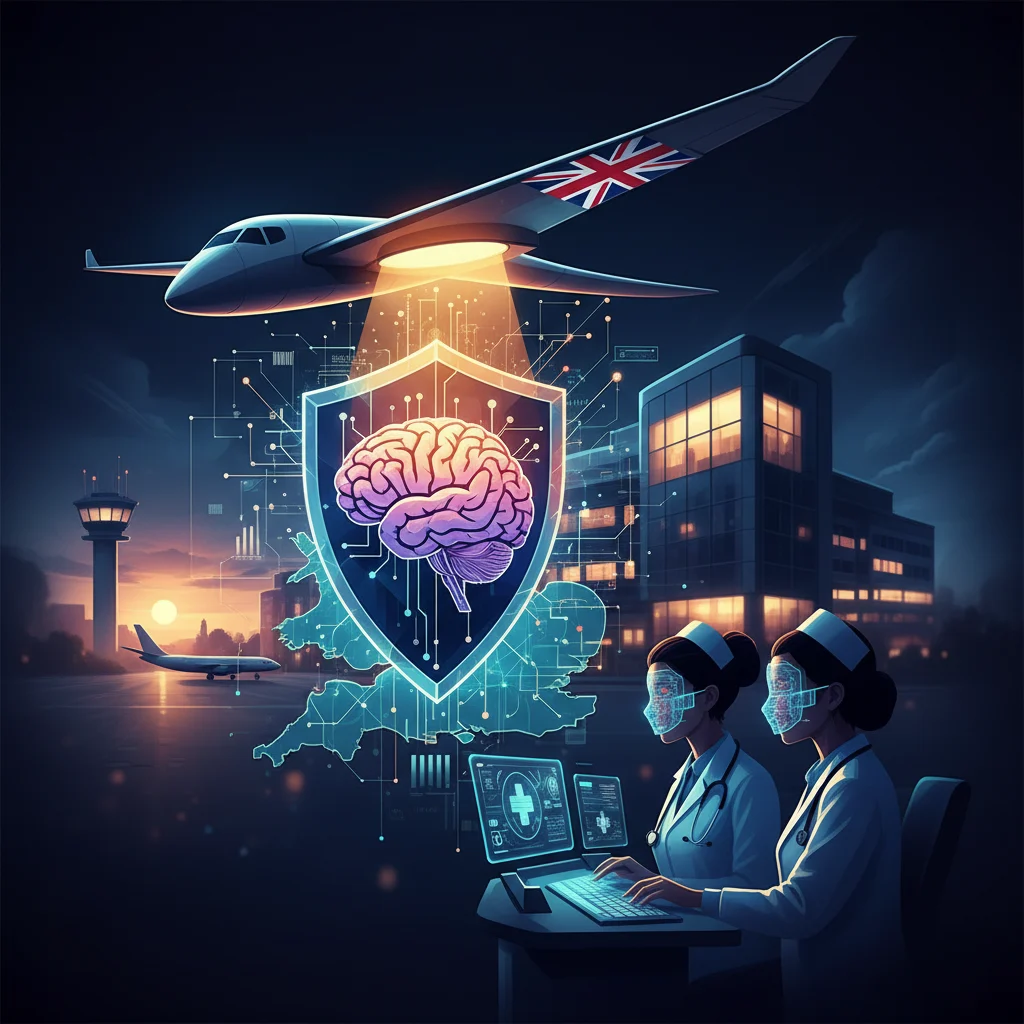
This article explores how the rigorous safety principles honed in aviation can be adapted to guide the responsible adoption of AI in UK healthcare, fostering a proactive approach to patient safety and clinical excellence.
The Imperative for Robust Safety: Why Look to Aviation?
Both aviation and healthcare operate in environments where human error or system failure can have catastrophic consequences. While the nature of the ‘systems’ differs – complex biological systems versus intricate mechanical ones – the underlying challenge of managing complexity, uncertainty, and human-technology interaction remains strikingly similar.
Aviation’s journey from a high-risk endeavour in its early days to one of the safest modes of transport today provides a powerful blueprint for developing robust safety protocols.
The aviation industry has achieved its safety record not by eliminating risk entirely, but by systematically identifying, analysing, and mitigating potential hazards through a culture of continuous learning and improvement. This proactive, systemic approach, rather than a reactive one, is what healthcare AI urgently needs to emulate.
The goal is to establish “flight rules” for clinical AI, ensuring that these powerful tools augment, rather than compromise, patient safety and clinical judgment.
Core Aviation Safety Principles and Their Clinical AI Parallels
Several foundational principles from aviation safety can be directly translated and adapted to the context of clinical AI. These principles focus on standardisation, training, human factors, incident learning, redundancy, clear responsibilities, and continuous monitoring.
Standardised Operating Procedures (SOPs) and Checklists
In aviation, every critical task, from pre-flight checks to emergency landings, is governed by meticulously developed Standardised Operating Procedures (SOPs) and checklists. These tools reduce variability, ensure critical steps are not missed, and provide a clear framework for action, especially under pressure.
For clinical AI, this translates to developing clear, evidence-based SOPs for the deployment and use of AI tools. This includes defining when an AI tool should be used, how its outputs should be interpreted, and what steps must be taken if its recommendations are unclear or contradict clinical judgment.
Checklists could guide clinicians through the process of reviewing AI-generated insights, ensuring all relevant patient data is considered and potential biases are acknowledged before making a final decision. Such standardisation would help integrate AI seamlessly and safely into existing clinical workflows across the NHS.
Rigorous Training and Certification
Pilots undergo extensive training, including simulator practice for various scenarios, and must pass stringent certification exams and recurrent checks. This ensures they possess not only the technical skills but also the cognitive and decision-making capabilities required for safe flight.
Similarly, clinicians interacting with AI systems need comprehensive training. This goes beyond simply understanding how to operate the software; it encompasses an understanding of the AI model’s capabilities, its limitations, the type of data it was trained on, and potential sources of bias.
Training programmes should equip healthcare professionals to critically evaluate AI outputs, recognise when an AI might be performing suboptimally, and understand the implications of integrating AI recommendations into patient care. Developing competency frameworks and certification pathways for clinicians using specific AI tools could become essential for safe practice in the UK.
Human Factors Engineering and User Interface Design
Cockpit design in aviation is a prime example of human factors engineering, where instruments, controls, and displays are optimised to minimise cognitive load, reduce the potential for error, and enhance situational awareness. The goal is to create an intuitive and forgiving interface that supports human performance.
Applying this to clinical AI means designing user interfaces that are clear, concise, and integrate seamlessly into existing electronic patient record (EPR) systems. AI outputs should be presented in a clinically meaningful way, highlighting key information without overwhelming the user.
Explainability – the ability of the AI to provide a rationale for its recommendations – is crucial, allowing clinicians to understand the basis of the AI’s suggestions and build appropriate trust. Poorly designed interfaces can lead to alert fatigue, automation bias, or misinterpretation, all of which pose significant risks to patient safety.
Incident Reporting, Analysis, and a Learning Culture
Aviation has a highly developed culture of incident reporting, where pilots and crew can report errors or near misses without fear of punitive action. These reports, along with “black box” flight recorder data, are meticulously analysed to identify root causes and implement systemic improvements.
This non-punitive, learning-oriented approach is fundamental to continuous safety enhancement.
For clinical AI, establishing a similar “AI safety reporting system” is vital. Healthcare professionals must feel empowered to report any instance where an AI system performed unexpectedly, provided incorrect information, or contributed to a near miss or adverse event.
This requires developing mechanisms for logging AI inputs, outputs, clinician overrides, and the rationale behind those decisions – effectively creating a “digital black box” for AI interactions. Systemic analysis of these incidents, shared across the NHS, would enable continuous improvement of AI models, deployment protocols, and training programmes, moving from a reactive to a proactive safety posture.
Redundancy and Fail-Safes
Aircraft are designed with multiple redundant systems and backup instruments to ensure that a single point of failure does not lead to catastrophic loss. Human oversight and the ability to revert to manual control serve as ultimate fail-safes.
In clinical AI, human oversight remains the most critical fail-safe. Clinicians must always retain the ultimate responsibility for patient care and have the authority to override AI recommendations.
Redundancy can also involve cross-referencing AI outputs with traditional diagnostic methods or seeking a second human opinion. Furthermore, AI systems should be designed with “graceful degradation” – meaning they should fail predictably and safely, providing clear warnings or reverting to a less complex mode rather than producing erroneous or misleading information when encountering unexpected data or system issues.
Robust backup plans are also necessary for when AI systems are unavailable or malfunction.
Clear Roles and Responsibilities in Human-AI Teams
In a cockpit, the roles of the Captain and First Officer are clearly defined, with established communication protocols and decision-making hierarchies. This clarity ensures effective teamwork and accountability.
As AI becomes a “team member” in clinical settings, defining its role and the clinician’s responsibility is crucial. The AI typically functions as an assistant or decision support tool, with the clinician retaining ultimate accountability for patient outcomes.
Protocols need to clarify when to trust, question, or reject AI recommendations. Effective communication between human and AI, such as the AI clearly indicating its confidence levels or the data points it considered, can enhance collaboration.
Establishing clear lines of responsibility helps prevent diffusion of accountability and ensures that patient safety remains the primary focus.
Continuous Monitoring and Auditing
Aircraft undergo regular maintenance checks, performance monitoring, and regulatory audits throughout their operational lifespan. This ensures that systems remain safe and compliant with evolving standards.
Similarly, clinical AI systems require continuous monitoring of their performance in real-world settings. This includes tracking their accuracy, detecting “model drift” (where performance degrades over time due to changes in patient populations or data input), and auditing their impact on patient outcomes.
Regular re-validation and updates of AI models are essential, especially as clinical guidelines or patient demographics evolve. Post-market surveillance, akin to that for medical devices, will be critical for AI, ensuring that systems continue to perform as intended and any unforeseen issues are identified and addressed promptly by developers and regulators like the MHRA.
Challenges in Translating Aviation Principles to Clinical AI
While the aviation analogy offers valuable insights, direct translation is not without its challenges. Healthcare presents unique complexities that differentiate it from aviation:
-
- Biological Complexity: Unlike mechanical systems, human biology is inherently complex, variable, and often unpredictable. Patient responses to interventions can differ significantly, making it harder to establish universally predictable outcomes for AI models.
- Ethical Dimensions: Clinical decisions often involve profound ethical considerations, balancing risks and benefits, patient preferences, and quality of life. AI, by its nature, lacks ethical reasoning and moral judgment.
- Data Quality and Bias: The performance of AI models is heavily dependent on the quality and representativeness of their training data. Biases in historical healthcare data can be inadvertently amplified by AI, leading to inequitable or inaccurate recommendations for certain patient groups.
- Regulatory Landscape: The regulatory framework for AI as a medical device in the UK (MHRA) is still evolving, particularly for adaptive or continuously learning AI systems. This contrasts with the highly mature and prescriptive regulatory environment in aviation.
- Automation Bias and Deskilling: Over-reliance on AI can lead to automation bias, where clinicians uncritically accept AI recommendations. There’s also a risk of deskilling, where fundamental clinical reasoning abilities might erode if not actively maintained.
Source: Nature